Neurolinguistic programming entered the therapy world as something of an outsider. Developed in the early 1970s by Richard Bandler and John Grinder at the University of California, it emerged not from clinical research but from the observation and modelling of exceptionally effective therapists — among them Fritz Perls, Virginia Satir, and Milton Erickson. The founders asked a deceptively simple question: what specifically do these practitioners do that makes them so effective?
The result was a set of frameworks describing patterns of language, representation, and behaviour that seemed to underlie rapid and lasting change. For decades, those frameworks have been applied, adapted, criticised, and refined within therapy settings. Understanding what they offer — and where their limits lie — is essential for any practitioner considering incorporating NLP into their work. For related reading, you can also explore more NLP articles from The Curious Bonsai.
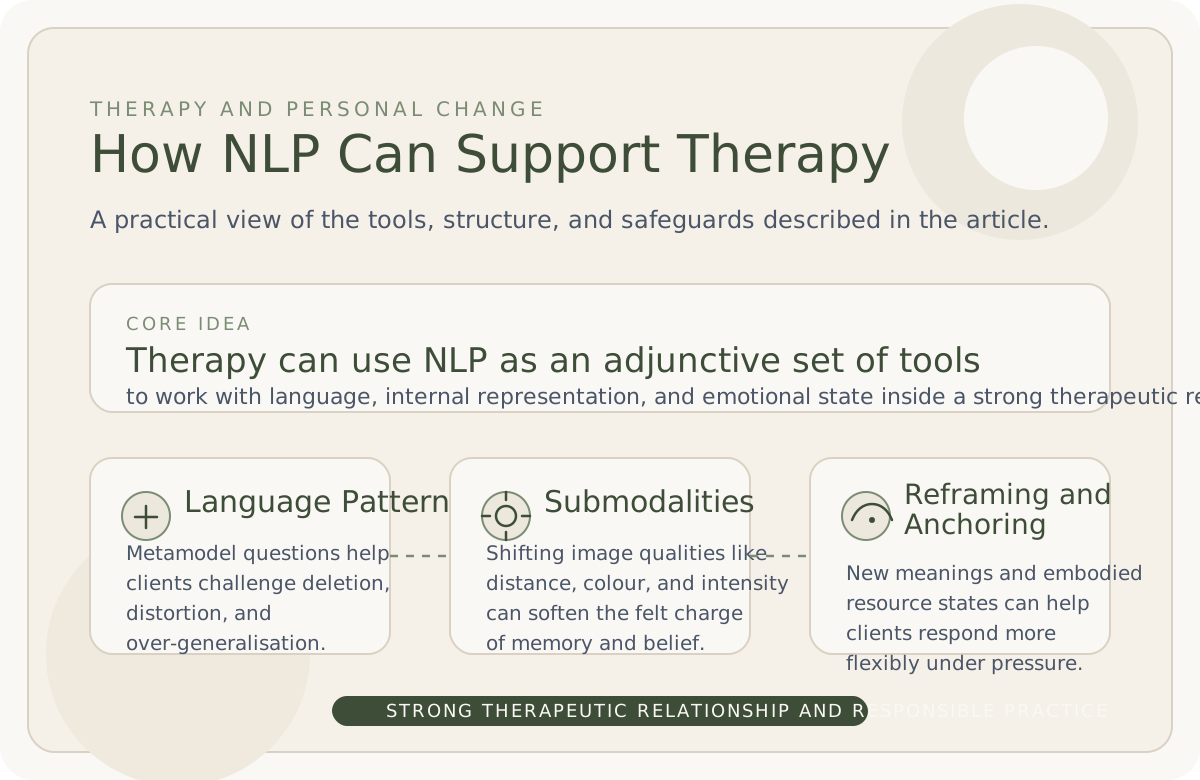
What NLP Brings to the Therapeutic Frame
At its most basic, NLP offers therapists a refined attentiveness to language. The Metamodel — one of NLP's foundational tools — is essentially a set of linguistic patterns through which people delete, distort, or generalise their experience when they talk about it. A client who says "I always end up being rejected" has made a universal claim from a limited set of experiences. A skilled NLP-informed therapist notices this and asks the kind of question — "Always? Has there ever been an exception?" — that invites the client to challenge their own over-generalisation.
This is not unique to NLP. Cognitive behavioural therapy, Socratic questioning, and even basic active listening all draw on similar principles. But NLP provides a particularly systematic vocabulary for noticing these patterns in real time.
The function of language is not merely to describe experience. It is to constrain and expand what we believe is possible within it.
Submodalities and the Structure of Experience
One of NLP's more distinctive contributions to therapy is its attention to what it calls submodalities — the fine-grained sensory qualities of internal representations. When someone recalls a distressing memory, NLP-informed practitioners might ask about the qualities of that internal image: is it in colour or black and white? Close or far away? Does it feel like it belongs in the present or the past?
The assumption is that these sensory qualities are not merely incidental features but part of the structure of how a memory or belief is held. Altering those qualities — moving the image of a painful memory further away, draining it of colour, reducing its felt intensity — can shift the emotional weight the memory carries.
There is a growing body of research in cognitive science supporting the idea that memory reconsolidation is possible — that the act of recalling a memory briefly renders it malleable before it is re-stored. Whether submodality work operates through this mechanism, or through something else entirely, remains an open question. But the clinical experience of many practitioners suggests that working at this level can produce meaningful shifts, particularly when combined with a well-established therapeutic relationship.
Reframing and the Flexibility of Meaning
Perhaps the most widely recognised NLP contribution to therapy is reframing. The principle is simple: events do not carry inherent meaning. Meaning is constructed by the person experiencing the event, and that constructed meaning can — with the right kind of invitation — be revised.
In practice, this manifests in two forms. Context reframing shifts the context in which a behaviour is evaluated. The quality that makes someone seem stubbornly inflexible in a relationship context may be what makes them reliably dependable in a professional one. Content reframing changes the meaning attributed to the event itself — not by denying the facts, but by offering a different interpretation of what those facts signify.
Good reframing is not superficial positivity. It does not ask a person to pretend their difficulty does not exist. It asks them to hold it differently — to notice that the frame they have placed around an experience is one choice among many.
Anchoring and Emotional State Work
Anchoring is the NLP term for a process related to classical conditioning: associating a physical stimulus with a particular emotional state so that the stimulus can later be used to evoke that state reliably. A therapist working with a client who suffers from performance anxiety might spend time helping them access and intensify a state of calm competence, then attach that state to a physical gesture — pressing thumb to forefinger, for instance — that the client can deploy before a difficult situation.
Critics rightly note that the mechanisms described in NLP's original anchoring framework do not map precisely onto what is known about conditioning in neuroscience. But the practical utility of the process — helping clients develop accessible, embodied resources — is consistent with what we know about the somatic dimension of emotional regulation — and it is why similar techniques carry through into NLP-informed coaching and executive development work.
Limitations and Responsible Practice
NLP is not a therapy in itself. It does not have a comprehensive theory of psychopathology, and it does not provide a model for understanding or treating serious mental illness. Its proper role in a therapeutic context is as a set of adjunctive tools — ways of working with language, representation, and state — that can enhance the effectiveness of a relationship-centred therapeutic approach.
Practitioners who use NLP responsibly do so within an ethical framework informed by their primary training, their duty of care, and an honest reckoning with what the evidence does and does not show. They do not make exaggerated claims about rapid cures. They do not substitute technique for attunement. And they remain curious about why something works, rather than simply reproducing procedures.
Within those limits, NLP offers a genuinely useful set of perspectives for therapists committed to working thoughtfully with the structure of human experience. Its best ideas — that language shapes perception, that patterns can be noticed and altered, that experience is structured and therefore changeable — are ideas that hold up well under both clinical scrutiny and lived practice.
This article is written for educational purposes and reflects the perspective of practitioners at The Curious Bonsai. It is not intended as clinical guidance. If you want the wider practice context or need to contact the team behind this resource, please use The Curious Bonsai contact page.